Why Is Soy And Corn Not Good For Chickens (Or Humans)?

Share on Pinterest

First it was butter. It started ‘the health war’ as I like to think of it.

Butter is bad!

No wait, butter’s fine but margarine is bad!

No, we retract that. Today margarine is all right but butter is the root of all evil.

Technically, butter and margarine are both bad and you should only eat olive oil.

Butter’s okay now, but you should really eat more olive oil!

Wait! Olive oil is fine as long as you don’t heat it! Try coconut oil if you want to heat it up! 

Does any of this sound familiar to ya’ll?

I figured out some time ago that there will never be ‘perfect’ foods for the human body. Paleo eating comes close, but I also think micro-evolution in humans moves quicker than people realize and some people can eat more modern food like grains with no ill effects. Or perhaps only some grains.

There are a couple of foods that unfortunately I’d say 80% of the population just shouldn’t eat even if they’re organic. If they’re NOT organic then that goes to 100%.

Corn and soy.

Two foods that are in 90% of all processed foods and almost all chicken feed. It is worth your time to make a corn-free/soy-free chicken feed or purchase this from a reputable company.

I can go on at length as to why GMO foods and corn and soy are not foods that most humans should eat, but I’d prefer to save my breath and let you see the neat charts and hear from the experts. When watching this I’d like for you to keep four things in mind:

    – I don’t believe in scaring people into doing things, but at the same time this is scary and people need to be aware!

    – What your chickens eat is what YOU eat

    – I don’t have a political agenda and I try to stay neutral here. Mostly because I think they’re all pretty darn corrupt so please don’t view this as a political statement

    – 50 years ago, doctors were promoting cigarettes as healthy and safe

NON-GMO SHOPPING GUIDE

Abridged Version of Genetic Roulette

ChickenCoop_LargeRectangle_v4_R4_AS

What Is Egg Bloom And Why Should You Care?

Share on Pinterest
There are no images.

Back when I wrote a couple of posts about egg refrigeration, I mentioned egg bloom quite frequently and promised an explanation later. Well, later has arrived so here is an explanation:

Egg bloom is the protective layer chickens internally coat their shells with that seals the pores of the egg to prevent contamination from bacteria and to help prevent moisture from escaping. This is all to ensure that the egg lasts as long as possible. It’s really amazing if you think about it. It’s just another way for Mama Hen to keep her eggs safe from harm and in turn it helps us.

Provided that bloom is still surrounding the egg, this is one of the reasons why I feel perfectly safe eating an unwashed egg from my backyard. I only wash them if they’re actually dirty and then they go in the fridge or are used right away.

Commercially, eggs are washed right away and then coated with oil. This doesn’t make a lick of sense to me, but I know most people who have never seen a farm animal in their life would prefer a washed, shiny egg versus a possibly dusty, matte egg that might have a feather sticking to it. This seems to me to be yet another example of our germaphobic culture, but that’s another story for another time.

Just like factory milk, we tend to hear a lot of scary stories about salmonella outbreaks in eggs. Where do these eggs come from? Generally from chickens raised in poor conditions (Ever visited someone who lives on a commercial chicken farm or close to one? Ugh!) these eggs are first given a chemical wash to remove dirt and the bloom, then recoated with a sort of ‘synthetic bloom’ as I think of it, which is mineral oil. Between the washing and the recoating and the already ill chickens, do these commercial eggs really stand a chance to be safe by the time they make it to the store?

Aside from chemical and bacterial invasions, though, the bloom also prevents the nutrients from escaping! If the bloom is intact there is no exchange of gases or evaporation of vitamins. No oxygen is getting into that egg, or in such small amounts that they’re miniscule. The egg will last longer and be healthier for you in the end. Once the gas exchange occurs, your egg starts to slowly rot and will not last half as long as it’s unwashed counterpart.

Easy Fall Projects Even YOU Can Do!

Share on Pinterest
There are no images.

When fall comes around it’s a great time to do some of those little projects that get put off during the spring and summer. Now that you’ve harvested all or most of your crops for the season, you have the time to turn your attention to things which can be done in advance of next year. A little work now means less for you in the spring!

Having chickens can be a big blessing when it comes to your garden. I’m not only talking about all the free manure but also how chickens will take care of that summer bug problem for you without needing to spray them with anything, organic or otherwise. Then the chickens leave little presents for the plants. Something for everyone.

However, we’re not all able to let our flocks run willy-nilly as we would like. In urban and suburban areas where yards may be a decent size but we still have to worry about neighbors, a chicken run is a better solution than letting them run around as nature originally intended.

An easy project to do for the fall months is to build an enclosure around your garden beds to ensure that chickens don’t run into neighboring yards or otherwise out of bounds. I can tell you from experience that chasing a chicken through your neighbor’s back yard is both funny and embarrassing. Especially in these days of Facebook and Youtube.

There’s another tip for you, don’t forget to clip their wings!

Anyway, you can purchase garden fencing from any local home improvement store fairly cheap. A lot of it is recycled, which helps, and plastic fencing is usually sold in rolls so it’s a matter of putting posts at the corners and a couple in the middle for support. Then wrap the fencing around and staple it in place.

I do suggest making actual gates, one on each end if you’re making it a rectangular enclosure. So two solid posts with swing gates or even child latch lattice ones. The latter worked quite successfully for us for a couple of years until the weather finally got to it. As cheap as they are, it worked for us to just replace it. You can also get a small metal gate door instead if you want to spend the money.

We had one gate coming down the path from the house, and the other gate connecting our garden to the end of the chicken run. After spring planting had passed and the bugs came out in force, we let loose the girls to have all the squash bugs, slugs, and whatever else they wanted to eat. The plants were grown, so they wouldn’t scratch up the seeds (that’s what chipmunks are for) and they really weren’t interested in more than an occasional peck at a broccoli leaf or a bit of spinach. Why would they when there were such fine specimens all over the plants?

Previous to this, we had dusted our squash plants with wood ashes, set out little beer traps for slugs, oil traps for earwigs… Wasn’t really necessary any more after the chickens were connected. Weeding, watering, and harvesting are hard enough without pest control, so build an enclosure and let your flock run free next year. This idea works really well with our mobile coop plans and the Chicken Fun Run, however the enclosure you build can be modified to adjust to any coop you want. You can even build it to connect to a greenhouse!

If you build a garden enclosure, drop us a line. We also love pictures!

When Eggs Go Bad . . .

Share on Pinterest

Photo by: Alessandra Hayden

Opening a bad egg is never pleasant. For my wife, opening a bad egg is usually followed by a trip to the bathroom and an avoidance of all eggs (or any food) until she doesn’t remember the incident anymore.

So how can you tell a bad egg from a good egg? For that matter, how long can eggs be safely stored (either in or out of the fridge)?

If you look at a good egg and a bad egg, from the outside they rarely look different. Inside is another story. There are a few ways that eggs start to rot:

  1. Once the egg has sat in one position so long that the yolk starts adhering to the inner membrane you are on the road to rotten eggs. This is why I always flip my eggs once a week to prevent the yolk from settling. If you do this, eggs last almost indefinitely.

  2. When the bloom of the egg is washed away, viruses and bacteria may enter and cause mischief. To prevent this, either don’t wash your eggs or wash them, dry them, and lightly coat them in something like sunflower seed oil to create a seal. About a century ago, they just rubbed the eggs in butter.

  3. Look for hairline cracks in your eggs. Feeding plenty of oyster shell to your hens helps to build stronger eggs, which will help prevent this problem. But if I get an egg with cracks in it, that egg goes straight to the dog that very day.

  4. The older an egg is, the larger the air pocket at the top between the inner membrane and the shell grows. This is why if you dump an egg in water, it will float when it gets too old to safely use. Eggs, safely stored, can last up to a year (yes really!) The best rule for this is to test any eggs you are unsure of by dunking them in water.

    1. Floaters immediately are thrown away (or saved until Halloween, shh!)

    2. Eggs that only have one end touching the bottom get used in baked goods because they’re still good but perhaps don’t taste as fresh.

    3. Eggs that are solid on the bottom are newer and perfectly safe to eat.

  5. When roosters mix freely with the hens, you sometimes run into situations where there are half-grown chicks inside the eggs and you just aren’t aware of it. Maybe it rolled away without you realizing it and you find it again, not knowing it wasn’t laid that morning. Things sometimes get mixed up. It happens. To prevent this, shine a flashlight through each egg before you store it to ensure that you aren’t stealing a little chicken baby.

In a future post, I’ll discuss more about what egg bloom is and why it’s important.

Ken Lang’s Chicken Coop Project

Share on Pinterest

Hi folks! An awesome guy named Ken Lang contacted me recently and let me know about the brilliant things he’s doing in his back garden. I asked him to write about it and provide plenty of step by step pictures.

“My name is Ken Lang and my wife’s name is Tina. We have been thinking about raising chickens for a long time. Our relatives eventually made up our minds for us. My sister-in-law purchased four Ameraucana chicks for us. Three out of four were killed by predators (coyotes and raccoons) This is when I decided to build a 99.9% predator proof coop. I lost the plan I ordered from John, but here is what I based my coop on. As you can see in the following article, I made a few changes, to fit my needs.”

coop-300x300
“I started with 4×6 posts, stapled hardware cloth to it, and added 1×6 to the bottom for strength. Then I dug ditches for two reasons: first to level the floor and second I filled them with concrete to discourage digging.”

coop-7-300x225

“Everything is screwed together to allow for somewhat easy removal. Next, I started the framing.”

coop-2-300x225
“If you look real close, this is where I installed the roost. Also I framed in the place where the nesting boxes will be later installed. (left side) Again, everything is screwed together.

Then, I put the siding and roofing on. We had some scrap cedar siding and some left-over roofing tin. This saved us a lot of money!”

coop-3-300x225
“Then I started on the run. We had some 1’ x 2” lumber left over from a cabinet shop. Did I mention, I am a cabinetmaker? You don’t have to be a cabinetmaker to do this. I made 3’ x 4’ panels from the lumber and hardware cloth, screwed them together with a 1” x 6” backer for strength, and made the run.”

coop-4-300x225
“If you look close at the door, it is on a pulley system that is activated from the outside. There is also a door on the back side. It is double-locked to keep predators out. As you may know, raccoons are very smart and can figure out how to open just about anything.”

coop-6-300x225
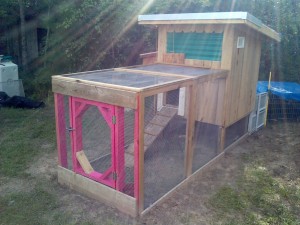
“This is our finished coop. I estimate this coop would cost about $375.00 to build if you have to buy all materials, but we had a lot of scrap lumber so we only spent about $250.00.”
 

coop-5-300x225
“We have since started adding on to the run. We learned that when you get new chickens they have to be acclimated slowly to establish a pecking order.”

ext-3-300x225
“I just added an extra one to what was already there. I cut a hole to match the opening in the left-over cabinet front found in my scrap pile and add a door. This will allow for separation at first, and then you can open the door when the new girls start getting along with the old girls.”

ext-2-300x225
“Just another view. This part only took me a day to complete. The girls love it and it is also 99.9% predator proof. I know this looks nothing like the original plan, but I had to improvise to suit my needs. Almost all dimensions match the plan. That is the beauty of it, you can use John’s plans and suit them to your personal needs. Thanks again John!”

ext-300x225

 Ready to start your very own chicken coop project? Just click here to get your hands on my world-famous plans 🙂

ChickenCoop_LargeRectangle_v4_R4_AS


Christmas Plum Jam (recipe)

Share on Pinterest

So here is the recipe I promised you all last week. My wife wrote it up especially for you all. We struggled for a while with what to call it because as I told her, it tastes like Christmas in a jar. So she called it Christmas Jam, even though I think it’s technically a preserve. I added the plum part myself.

20131010_143553-300x225

  • 6 or 7 sterilized pint jars, or equivalent jelly jars
  • 8-10# of plums washed, pitted, and diced (enough to fill a gallon jar)
  • 2-3 TB of lemon juice
  • 2 ½ c. sugar (coconut sugar works, but it will be a bit more brown)
  • ½ c. low to no sugar pectin powder
  • ½ c. honey
  • 2  c. water
  • ½ tsp cardamom
  • ¼ tsp cloves
  • 1 tsp cinnamon
  • 2 tsp vanilla extract

I used red plums for this recipe, but I think black ones would look prettier. Wash, pit, and dice your plums but leave the skins on. Fill a gallon jar with the plums, squeeze the lemon juice over them, and leave them overnight in the fridge.

Pour all of your plums into a large pot the next day, cover with two of the cups of sugar and water and turn on the heat to simmer them. As they are cooking, you may want to blend up about ⅓ of the pot with a hand blender to make a richer preserve. In a small cup or bowl, add the ½ cup of sugar remaining to the pectin and mix together. Set this aside.

20131010_143517-300x249Simmer the plums and sugar until the skins start to burst and everything has softened. Add the honey and spices and stir until it starts to boil. When it is boiling, add your pectin/sugar mixture to the pot and stir to ensure there are no lumps. The jam will start to thicken instantly. Continue to cook it down for another minute or two. Then turn off the heat, add the vanilla extract, and stir again. Scrape down the sides of the pot and pour into sterilized jars. Wipe the edges, put the sterile lids on, and process in a water bath for 10-15 minutes. Makes 6 pints of jam. Plenty to keep some and give away some for the holidays. Especially in the cool new blue jars Ball sells!

20131011_144345-300x176

Pros and Cons of Egg Refrigeration

Share on Pinterest

Photo by: Doug McCaughan

This may be a new subject for some of you, but anyone who’s been talking shop with fellow chicken aficionados will eventually hear a passionate debate on the pros and cons of keeping eggs cold.

Unless you were raised in Europe, you were probably taught that eggs always belong in the fridge and that’s that. The fact that this is even a debate may be an eyebrow raiser for you. But since we are going into the colder months, this is a great time to mention a new way of storing eggs.

If you think about it, raising chickens for eggs has been a way of life for people around the world for centuries. And they certainly didn’t always have a way to keep them in cold storage! It’s a fallacy to think that ancient peoples ate spoiled food because they didn’t. What makes us sick made them sick, too.

If you happen to be able to tour an old estate or go visit an Amish farm, you might see how they did things in years before. They usually had a spring house, which was built over or next to a spring or well and made of stone to insulate against the summer heat. This little structure is where they would store milk, cheese, eggs, yogurt, etc. to keep a consistent temperature year round. Even to the point of putting everything in a sealed container and lowering it on a rope into the spring or well so the water would keep it cold. There were usually shelves for eggs and cheese on the side, even in the heat. However during the temperate seasons, eggs and cheese would go right on the pantry shelf inside their homes. I suspect sometimes in the not so temperate seasons as well, but that’s purely speculation.

So what is the danger here? Provided you were responsible for raising the chickens yourself, there really isn’t much danger at all. Just like with raw milk from cows you raised yourself, as long as you know what you’re doing (mostly sanitary things) then the end product is perfectly safe. Don’t tell that to the USDA or FDA, of course. Then, they tell you that raw vegetables are a safety hazard. I suppose with conventional produce that hasn’t been washed this could be very true. The same goes for factory-farm eggs. I’d rather trust the farm-fresh unwashed egg that has been stored at room temperature to the factory-farmed egg that has been washed, bleached, pasteurized, and kept in a fridge.

It really comes down to what you personally feel is safe for you and your family. Doing your own research on the differences between family farm eggs and factory farm eggs may help you make that choice. Keep in mind, the eggs that the USDA and FDA usually test are directly from factory farms. Chickens kept in those conditions are generally very unhealthy. Sick chickens = eggs that can make people sick.

Anyway, I have personally stored my eggs on a little shelf in the walk-in pantry for years. I know that the temperature of the pantry is relatively stable because I’ve shut off the heat vents to that small room and it’s located under shady trees. The little gauge on the wall always says between 55-68 degrees. This is a great temp to keep just about anything fresher for longer. I also like to put desiccant packs around that room to prevent humidity as well, but that’s more for the dry storage than the eggs.

Here are some general guidelines you should follow if you want to keep eggs outside of the fridge:

  • Don’t wash them, the bloom protects the egg inside from bacteria and viruses

  • Keep them below 74 degrees for optimum freshness

  • Flip the eggs upside down once a week to prevent them from rotting

  • Cover lightly with straw or paper

  • If you must wash your eggs, coat them lightly in oil

  • Once you refrigerate an egg, keep it there. Don’t store it at room temperature after you’ve already put it in cold storage.

In a future post, I’ll discuss egg bloom, why it exists, and discuss the merits of washing versus not washing eggs and mention a bit more about how eggs go bad as well as testing for bad eggs.

Fall Fruit and Almond Cake (recipe)

Share on Pinterest
There are no images.

When Mrs. White makes something she is particularly proud of, I like to share it with people I know. Since I know many of you here not only raise chickens, going forward I will also share things that are not purely chicken related here on this blog. If you’re looking for a way to connect this to chickens, it has eggs in the recipe!

She is going to experiment with changing this to a gluten free recipe by making it with coconut flour next time. I’ll keep you posted as to how that goes.

20131010_204747

  •         2 small to medium tart apples, cored and diced
  •         2 small plums, pitted and diced
  •         1 ½ c. AP or cake flour
  •         1 TB baking powder
  •         ¼ tsp salt
  •         4 eggs (room temperature, very important!)
  •         ½ c. coconut oil or unsalted butter, softened
  •         1 c. sugar
  •         ½ tsp vanilla extract
  •         ½ tsp almond extract
  •         ½ c. milk
  •         ¾ c. toasted, unsalted sliced almonds

Preheat oven to 350ºF. Dump the fruit on a paper towel and set aside until you’re ready.

In a large shallow bowl, mix together the flour, salt, baking powder, and ½ c. of the almonds. Make a well inside the bowl and cream the butter and sugar together with the back of a spoon until combined. Add the eggs one at a time to the butter and sugar until combined well.

Add the extracts to the milk in a measuring cup.

Slowly stir in half the flour, add half the milk, stirring together. Then work in the remaining flour and lastly the remaining milk until all is combined. Hey, you only used one bowl and a measuring cup!

Spray a cake pan (I used a 10” round one. You can also use a 9×13 rectangular pan) and dust lightly with flour. I like to use Trader Joe’s coconut oil in a can to spray my pans with. It doesn’t have too many weird things in it.

Pour half the batter in the bottom of the pan. Sprinkle your fruit evenly on top of this layer, then cover with the remaining batter. You may need to smooth it over the fruit in some places with a spoon. Once it’s all mostly covered, sprinkle the top with the remaining almonds and bake for 25-35 minutes depending on how deep your cake pan is. Test for doneness when the edges are browned and start to pull away from the pan. To test, poke a toothpick or a fork into the center. If it comes out clean your cake is done.

Let it cool a little, then flip out onto a plate (make sure the almond side somehow settles upright) and drizzle a tiny bit of honey on top. Slice and serve while still warm. Makes a lot. Great for having with a cup of tea with a friend or five.


20131010_204426My wife also made a great plum jam with a lot of our plums this year. I’ll be sharing that next week after she writes up the recipe. If you have a recipe you’d like to share, please don’t hesitate to send it to me in an email.


Toxic Environment: Practical Solutions To Keep Your Flock And Family Safe! (Part II)

Share on Pinterest

So you’ve found your great dual purpose breed and have made the commitment to stop buying commercial chicken. What next?

I have to say that for most people, it’s impossible to keep enough chickens to feed their family all year long. Or perhaps they live in an urban area with restrictions on how many chickens are allowed. In this instance, I would suggest joining a local CSA, buying club, or hunt down your local farmer’s market. Here in Kentucky, there is a strong local movement and you can find an abundance of locally produced, GMO free food. Even if it’s not organic, many farmers locally have committed to feeding their animals naturally and provide plenty of access to pasture land. You can look for ASH free, which stands for Antibiotic Steroid Hormone free.

Even then, you have to be willing to pay the usually higher prices. It’s a personal choice: do you want to eat chemicals and GMO’s or not? Even surface research will turn up the dangers of modern industrialization on health. I won’t scare you with that today. What I will say is that every person on the planet deserves access to clean food and water. You and/or your children certainly do. So skimming a little off of your cable bill to pay for fresh food is a wise investment in the future.

For some, especially after the tumultuous recent years, it still isn’t feasible. To you I encourage not to feel guilty and to look at other ways you can make the best of things. A lot of farmers work in trade, so if you have extra time on your hands make friends with the farmers in your community (maybe at the farmer’s market) and offer your labor in exchange for food. This is a solution that helps everyone, building strong friendships and communities.

Or get your church or other group involved in group buying or building a garden. There are several churches locally that have not only built community gardens, but community farms with chickens and goats to nourish the community both physically and spiritually.

If you do happen to be lucky enough to have enough land to raise chickens for your whole family then how are you going to feed them?

Buying organic, non-corn, non-soy, non-GMO feed is ridiculously expensive as some of you are probably aware. If you have the money to purchase that then by all means do so. For the rest of us, there are ways to get around that cheaply.

Commercial feeds generally are the cheapest ingredients possible mixed into a pellet. Like dog and cat food, it’s poorly regulated and what’s in it today may be something different next month without notice to you or your flock.

To avoid this problem, it’s simple enough to make your own feed. I hear the groans already, but it’s not as hard as you may think. Bear with me for a moment.

There are recipes all over the internet for making your own chicken feed. A brief search on google turns up hundreds. What you want to look for is no soy, no corn, and generally easy to procure ingredients. Anything too fancy or expensive fed to BIRDS and I’m going to sit in the corner and cry when I get the bill.

To source ingredients, there are a lot of places you can look. If you’re part of a buying club locally then that’s the best place to go for bulk bags of winter wheat, oat groats, sunflower seeds, etc. If you want organic, this will definitely be your cheapest option. I’m usually just happy with GMO free for chickens unless it’s something I know is sprayed heavily, in which case I will go with organic only. Cotton tends to be sprayed with pesticides heavily, so cottonseed meal is a definite no-no. 63% of wheat in the US has significant levels of malathion, among other toxins. Corn is almost always GMO, about 75% of the corn grown in the US. Ditto for soybeans.

For more information, check out this link:

http://www.inspirationgreen.com/food-organic-choices.html

In upcoming posts, what would YOU like to see addressed? Leave a comment below and let your voice be heard.